


T-slot ground rail
Contact Info
- Add:, Zip: 061000
- Contact: 谢佳宁
- Tel:15350773479
- Email:3622313939@qq.com
Other Products


Quick and convenient installation and debugging methods for the popular cast iron ground rails in the cast iron industry
Cast iron ground rails absorb some sulfur from the coke. The melting speed of the cupola furnace is fast. When one batch of cast iron ground rails is poured, and the next batch is processed, the temperature inside the ladle remains high. The molten iron from the cupola furnace is poured into the ladle with minimal temperature loss. During spheroidization treatment, the tapping temperature of cast iron ground rails can be slightly lower compared to electric furnaces, with little or no impact on the quality of spheroidization treatment (melting and absorption of spheroidizing agents, pouring temperature).
In induction electric furnaces, synthetic cast iron is affected by factors such as 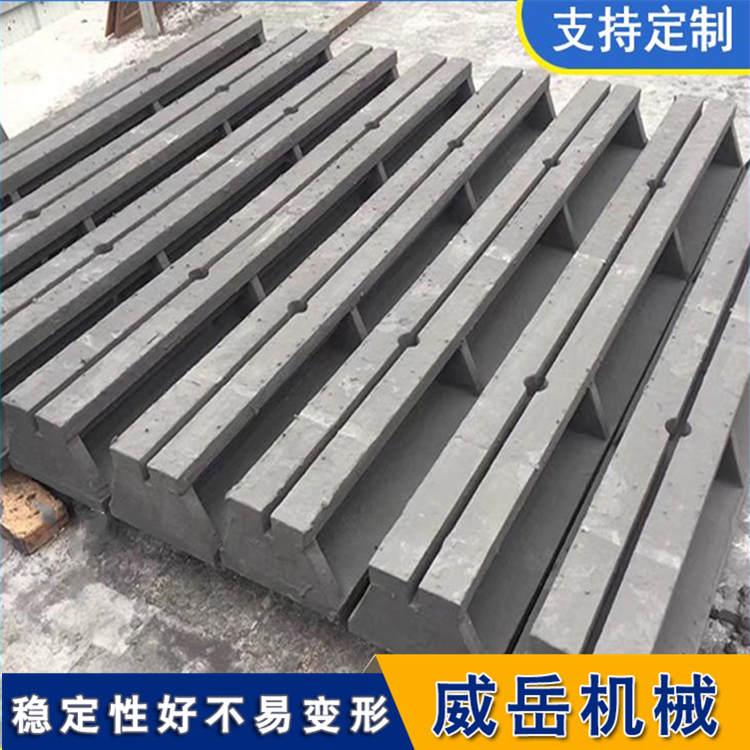 excessively low sulfur content in cast iron ground rails, high superheating temperature, and friction from current stirring. These factors significantly reduce the graphite nucleation cores in the molten iron of cast iron ground rails. This lack of graphite crystallization cores results in a large undercooling degree and poor response to inoculation treatment. It is difficult to achieve the desired microstructure of cast iron ground rails through conventional inoculation measures. Therefore, even if the chemical composition fully meets the requirements, the cast iron ground rails often exhibit high hardness, making them difficult to machine.
In gray cast iron ground rails, when the sulfur content is less than 0.06%, some beneficial effects of sulfur cannot be realized. The presence of fine and dispersed sulfide inclusions in cast iron plays a beneficial role in the nucleation and growth of graphite. Synthetic cast iron produced by melting scrap steel and adding carbonizers in induction electric furnaces generally has a final sulfur content not exceeding 0.03%.
In the production of investment casting for cast iron ground rails, mold making is a critical process and the primary condition for obtaining cast iron ground rails. However, due to neglect of this process, defective wax molds may flow into the shell-making and pouring stages, resulting in irreparable waste. Even if they do not proceed to the next stage, they still waste labor and production time. Therefore, addressing surface issues of wax molds is one of the main tasks in investment casting.
Internal pores in cast iron ground rails are inspected using ultrasonic and radiographic testing, while surface pores are inspected using penetrant or magnetic particle testing. Identifying various types of pores requires not only examining their shape, size, and distribution but also, at times, analyzing their causes by measuring the chemical composition of the alloy, the content of various gases and impurities dissolved in the molten metal, the composition, moisture, and gas generation of coatings, and checking and analyzing the pouring system and venting conditions of the cast iron ground rail mold. If necessary, metallographic, scanning electron microscopy, and transmission electron microscopy tests, along with other analyses, are required to accurately identify the type and cause of pores.
Irregular flow marks on local surfaces are caused by excessive use of parting agents in the mold cavity of cast iron ground rails or uneven application leading to local accumulation. In the production of cast iron ground rails, to prevent wax molds from adhering to the surface of the mold cavity and to facilitate demolding, a layer of release agent or parting agent is brushed onto the surface of the mold cavity before molding.
Although the tapping temperature of cupola furnaces is generally around 1450°C, when the molten iron of cast iron ground rails passes through the superheating zone, the furnace temperature is about 1700°C. Even though the molten iron passes through the superheating zone in the form of fine droplets, it achieves high-temperature superheating, which helps dissolve graphite into the molten iron and reduces the hereditary tendency of coarse graphite flakes in the iron.
Pores distributed in clusters formed by chemical reactions between certain components within the molten metal of cast iron ground rails or at the interface between the molten metal and the core are called surface needle holes or subcutaneous pores. These are caused by interfacial reactions between the molten metal of cast iron ground rails and the mold or core coatings, and they appear as scattered or clustered needle-like reaction pores distributed across the entire cross-section or in specific areas of the casting.
Weiyue Machinery, Ms. Xie, 15350773479
| Industry Category | Others |
|---|---|
| Product Category | |
| Brand: | 威岳 |
| Spec: | 2000*4000 |
| Origin: | 111309 |


